Your Schedule Isn't Empty Because Patients Don't Want Care
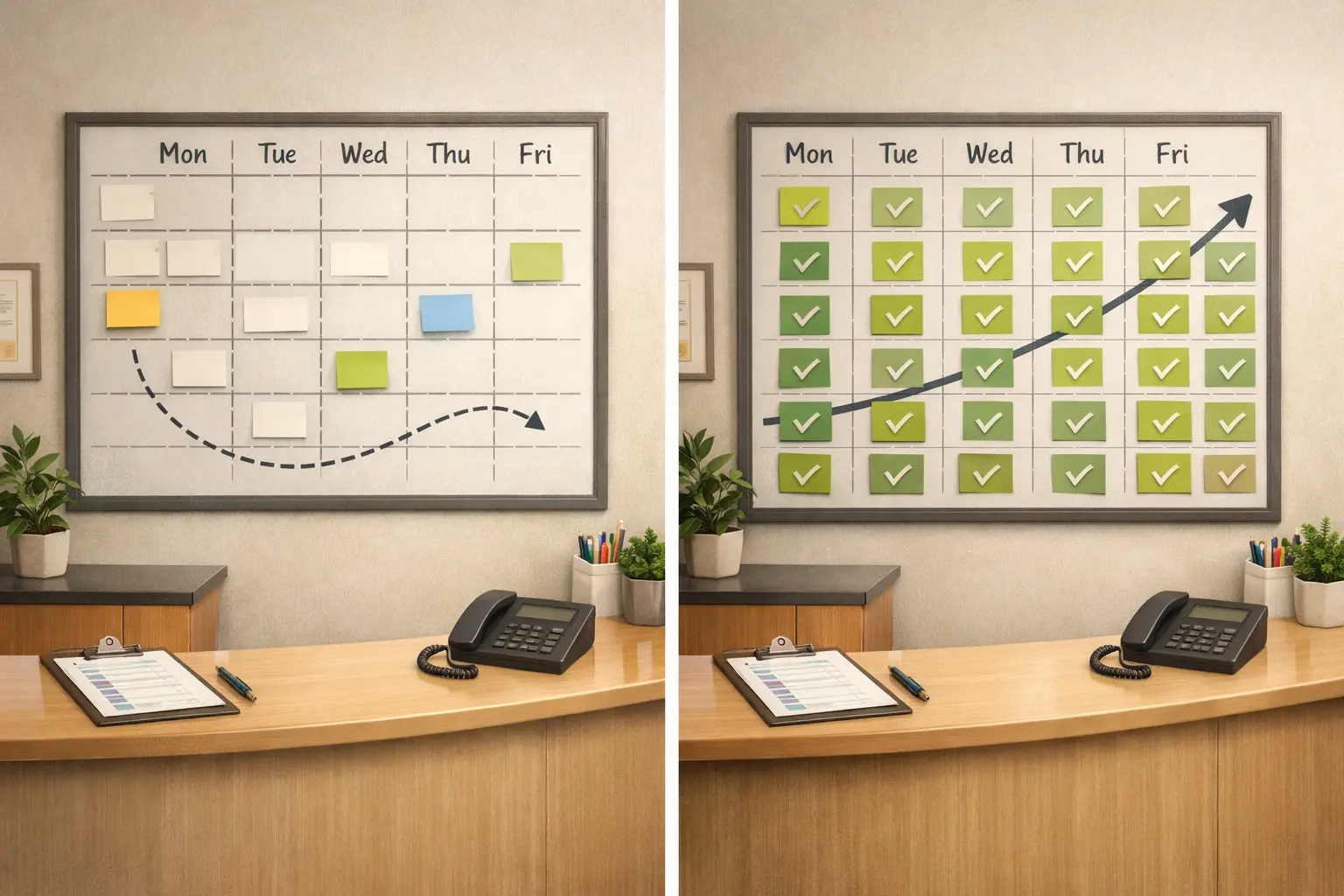
Most dental offices don't have a demand problem.
They have a follow-through problem.
If you trace an empty chair backward, you usually won't find a marketing failure. You'll find something quieter: a patient who meant to schedule later, hygiene that slipped overdue, treatment that was explained clearly—but never booked.
These aren't dramatic breakdowns. That's why they're dangerous. They compound quietly.
The practices that stay consistently full aren't doing anything flashy. They've just removed the places where follow-through depends on someone remembering to do the right thing on a busy day.
Where Most Practices Actually Leak Patients
Before talking about solutions, it's worth being honest about where schedules usually fall apart:
- Recall lists that get run "when there's time"
- Follow-up that stops when the schedule is full
- Front desks acting as the safety net for everything that didn't happen earlier
None of this is negligence. It's what happens when critical work is invisible and no one owns it end to end.
That's the gap we kept seeing over and over.
Why Recall and Reactivation Break Down in Real Life
Most recall systems fail for one simple reason: they're episodic.
Someone runs a report. Messages go out. A few patients book. Then the office gets busy again and the process stalls. By the time recall is revisited, the list is larger, colder, and harder to convert.
When we started working with practices on this, one pattern stood out:
Offices weren't short on patients—they were short on consistent follow-through.
That observation is what eventually led us to build our patient reactivation and recall system—not as a campaign tool, but as infrastructure.
What Changes When Recall Runs in the Background
Instead of relying on bursts of effort, the system runs continuously:
- Patients are grouped by why they're overdue, not just how long
- Outreach is spaced intentionally instead of blasted all at once
- Only patients who don't respond are escalated to personal follow-up
In one mid-sized general practice we worked with, this approach reduced overdue hygiene patients by 31% over six months—without adding front desk hours or increasing outbound calls.
No clever copy. No discounts. Just fewer dropped balls.
The Front Desk Shouldn't Be the Safety Net
This is where most offices feel the relief.
When recall and reactivation are handled systematically, the front desk stops being the catch-all for work that didn't happen earlier. Instead, they step in at the moment they're best at: when a patient is ready to schedule and needs a human.
That shift matters.
It's the difference between feeling behind all day and feeling in control of the flow.
Why Consistency Beats Campaigns (Every Time)
The offices that see the biggest gains don't "turn on" recall when the schedule is light and "pause" it when things get busy.
They let it run all the time.
That's what keeps the schedule from swinging wildly month to month—and why reactivation feels boring in the best possible way.
The Takeaway
Patient reactivation doesn't fail because patients don't respond.
It fails because follow-up is treated like a task instead of a system.
Once recall is consistent, predictable, and mostly invisible, something interesting happens: the schedule starts to stabilize on its own.
That's not marketing. That's operations.
A Quick Gut Check
If you're evaluating your own practice, ask yourself:
- How many overdue patients do we have right now?
- How many have been contacted more than once in the last 90 days?
- How many of those actually converted into scheduled visits?
If you don't know the answers, that's usually where the opportunity is.
If You're Curious What This Looks Like in Practice
Every office is a little different—volume, staffing, patient mix. If you want to talk through how a recall system like this would work in your practice, we're happy to walk through it with you.
No pressure. Sometimes just mapping the leaks makes the solution obvious.
Related Topics
Ready to Automate Your Practice?
Join modern dental practices using Operaitor to answer every call, book more appointments, and grow 24/7.
No credit card required for demo